Written: August 1, 2026
Before Greece had Aphrodite and Rome had Venus, Mesopotamia already knew a goddess who could start a war and end a drought in the same breath. Her Akkadian name was Ishtar. Her older Sumerian name was Inanna. For thousands of years, people looked up at the morning and evening star and saw her walking the sky.
Ishtar is not a soft myth made for greeting cards. She is desire with a blade in it. She is fertility that refuses to be polite. She is political power dressed as beauty, and beauty that knows how to command an army. If you have ever felt pulled toward something that both thrills and unsettles you, you already understand something of her ancient pull.
Who Was the Ancient Goddess Ishtar?
Ishtar was one of the most important deities in the Mesopotamian pantheon. In Akkadian, Assyrian, and Babylonian religion, she stood at the center of love, sex, fertility, and warfare. Scholars usually treat her as the later form of the Sumerian goddess Inanna, whose cult in Uruk reaches back into the late fourth millennium BCE. Over time, as languages and empires shifted across the Tigris and Euphrates, Inanna and Ishtar fused into one towering figure remembered as Queen of Heaven.
That fusion matters. Mesopotamia was never a single frozen culture. Cities rose, kings fell, dialects changed, and temples reinvented themselves. Through all of it, this goddess kept expanding. She gathered local titles, absorbed related goddesses, and became a shared language for power, longing, and cosmic order. When later writers speak of Ishtar, they are often speaking of centuries of layered devotion, not one tidy biography.
Her domains sound contradictory only if we expect ancient religion to behave like a modern specialty. Love and war shared the same charged energy: attraction, risk, conquest, surrender. Ishtar ruled the heat between bodies and the heat between armies. She blessed kings, threatened rivals, and reminded worshippers that life itself is a negotiation with force.
Inanna and Ishtar: One Goddess, Many Names
In Sumerian texts she is Inanna. In Akkadian she is Ishtar. Related figures appear farther west as Astarte and, through long cultural exchange, leave fingerprints on later Mediterranean goddesses of love and desire. The point is not that every later goddess is simply “Ishtar under another name.” The point is that Mesopotamia produced an early, powerful model of a divine feminine that was neither meek nor merely maternal.
Early Inanna was tied to the storehouse and the prosperity of the city. Gateposts and reed emblems marked her presence. As her cult spread, she became more explicitly astral: the planet Venus as morning star and evening star. That double appearance helped people think of her as a being who crossed thresholds—day into night, life into death, desire into danger.
Royal ideology also shaped her. Akkadian rulers such as Sargon and his successors invoked Ishtar often. Kings needed divine endorsement. Ishtar offered it in a form that mixed charisma with violence: she could favor a ruler’s rise, then abandon him if he failed the sacred order she represented. In a world where kingship was theology as much as politics, that made her indispensable.
Symbols That Told Her Story Without Words
Ancient people did not need a long lecture to recognize Ishtar. Her symbols did the talking.
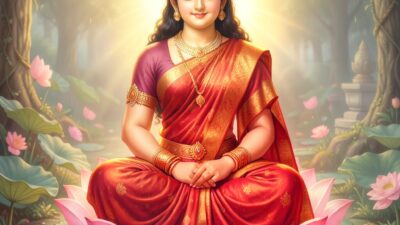
The eight-pointed star linked her to Venus and to heaven’s bright authority. Lions signaled ferocity, royal power, and the right to stalk the battlefield. In warrior images she may appear with weapons rising from her shoulders, a visual shout that love’s goddess also knew how to fight. Earlier emblems connected her to storehouse gates and abundance. Together, these signs built a portrait of a divinity who guarded both the city’s wealth and the city’s courage.
Art also played with revelation. In some Near Eastern traditions associated with her sphere, the goddess is shown nude or parting a cloak—an image of unveiling rather than shame. Modern eyes sometimes misread that as simple erotic display. For many ancient viewers, it could also mean fertility made visible, divine presence made intimate, or power refusing concealment. Context always mattered. Not every nude female figure in Mesopotamian art is Ishtar, and careful scholarship warns against collapsing every motif into one name.
Still, the surviving image language is consistent enough: star, lion, weapons, radiance, and a body that does not apologize for desire. That is why Ishtar remains so visually memorable long after her temples fell silent.
Temples, Cities, and the Geography of Devotion
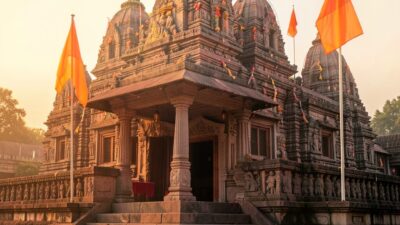
Uruk was her great early center, home of the Eanna temple complex. From there, worship spread widely. Temples and shrines dedicated to Inanna/Ishtar stood across Mesopotamia—in cities such as Ur, Nippur, Babylon, Kish, and many others. A goddess this important could not remain a local secret. Merchants, soldiers, and royal courts carried her name along roads and rivers.
Temple life was social as well as sacred. Clergy included men and women, and Mesopotamian sources also preserve categories of cultic roles that do not map neatly onto modern gender binaries. Ritual calendars, offerings, hymns, and civic festivals kept Ishtar woven into ordinary time. People did not visit her only when they wanted romance. They approached her for protection, for fertility of land and household, for victory, for legitimacy, and for the courage to face what they feared.
Because temples were economic institutions as well as holy places, Ishtar’s cult also meant land, labor, and redistribution. Religion in Mesopotamia was never only private belief. It was infrastructure. To honor Ishtar was to participate in a civic system that believed the gods kept the world from tipping into chaos.
Love, Sex, and the Sacred Charge of Desire
Modern readers often reduce Ishtar to “the goddess of love,” then stop. That truncation misses her seriousness. In Mesopotamian thought, sexual love was creative force. It bound households, secured lineage, and mirrored cosmic vitality. Ishtar’s erotic power was not decorative. It was generative.
Myths and hymns celebrate her allure, her agency, and her refusal to be owned. She chooses. She pursues. She rejects. She can bless a lover or devastate one. That emotional range made her a realistic goddess for people who knew that desire can heal and also undo. If your own life has ever shown you that intimacy is never only soft, Ishtar’s ancient reputation will feel strangely contemporary.
Scholars still debate details of cult practice, including how far later writers exaggerated claims about sacred sexuality. What remains clear is that sexuality sat near the heart of her identity. Fertility of bodies, flocks, and fields belonged to the same sacred economy. Desire was not separated from survival.
The Warrior Queen: Why Love and War Shared One Throne
Ishtar’s war aspect startles people who expect goddesses to specialize in gentleness. Mesopotamia did not. Storm, flood, invasion, and palace intrigue were facts of life. A goddess who could only soothe would have been incomplete. Ishtar entered battle hymns as a storm of divine aggression, a patron who could break enemy lines and terrify kings who opposed the cosmic order.
This is one reason she mattered to empire. Assyrian and Babylonian rulers needed a divinity who understood conquest as well as courtly splendor. Ishtar could stand beside a king as lover of the city’s prosperity and as scourge of its enemies. The same fierce vitality that made life blossom could also be turned outward as war.
Seen this way, her “contradictions” become coherence. Passion concentrates. It can create a child, a poem, a kingdom—or a battlefield. Ishtar personified that concentration. She taught that sacred power is not always safe, and that what we call love may share a root with the will to prevail.
Descent to the Underworld: The Myth That Defines Her
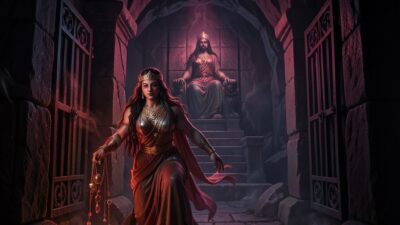
The most famous story attached to Inanna/Ishtar is her descent into the underworld. In the Sumerian poem, Inanna decides to enter the realm of her sister Ereshkigal. At each of seven gates, she is stripped of garments and symbols of power until she arrives naked and vulnerable. She is judged, killed, and hung on a hook. The world above begins to wither. Through divine negotiation and loyalty—especially involving her attendant Ninshubur and, in related traditions, the fate of her consort Dumuzid/Tammuz—she returns, but not without cost.
Akkadian versions tell related stories of Ishtar’s descent. Details shift with language and period, yet the pattern holds: the goddess of life crosses into death, loses everything that marked her status, and comes back changed. The myth is not a simple rescue tale. It is a theology of thresholds. Power must pass through emptiness. Fertility depends on cycles that include loss. Even a queen of heaven cannot treat the underworld as a tourist stop.
Readers still return to this story because it feels emotionally true. Ambition has a price. Transformation demands surrender. Love can require a kind of death—of pride, of certainty, of the old self. Ishtar’s descent gives those human experiences a cosmic stage without turning them into cheap slogans.
Dumuzid, Sacred Marriage, and the Drama of the Seasons
Ishtar’s relationship with Dumuzid (Tammuz) sits near the heart of seasonal and royal symbolism. In sacred marriage traditions, the union of goddess and king or goddess and consort could represent the renewal of land and legitimate rule. When the consort suffers, dies, or is taken to the underworld, mourning rituals and seasonal imagery follow. Life pauses. Then, somehow, it returns.
These stories are not identical across every tablet or century, and modern reconstructions should stay humble. Still, the emotional architecture is durable: desire binds heaven and earth; separation brings drought or grief; reunion restores order. Farming cultures understood that abundance is cyclical. Ishtar’s myths gave that cycle a face, a voice, and a dangerous beauty.
Enheduanna and the Power of Hymns
One of the most remarkable voices connected to Inanna/Ishtar is Enheduanna, high priestess and daughter of Sargon of Akkad, often identified as one of the earliest named authors in world literature. Her hymns to Inanna are intense, political, and personal. They show a goddess who can elevate and overturn, who receives praise not as a distant abstraction but as a living force active in court and crisis.
Through such texts we hear how elites and temple communities spoke to their goddess: with awe, intimacy, complaint, and strategy. Ishtar was not only worshipped. She was argued with, petitioned, celebrated, and feared. That literary record is part of why she still feels so present. She left words behind, not only ruins.
What Ishtar Still Asks of Us
You do not need to rebuild a temple in Uruk to learn from Ishtar. Her ancient profile challenges modern habits of splitting the self into tidy compartments. Ambition over here. Tenderness over there. Courage in one room, desire in another. Ishtar refuses the split. She suggests that vitality is whole, and that wholeness can be fierce.
She also warns against naive romance. Desire without wisdom becomes appetite. Power without reciprocity becomes tyranny. The descent myth insists that even radiant beings must face the dark and pay a price for return. In a culture addicted to permanent ascent—more status, more glow, more winning—Ishtar’s older wisdom sounds almost radical: transformation includes stripping. Renewal includes grief.
For readers drawn to goddess traditions, Ishtar offers a model of sacred femininity that is complex rather than ornamental. She is not only mother, not only lover, not only warrior. She is the meeting place of those energies. That is why artists, poets, and spiritual seekers keep circling back to her star and her lion. She names a truth people keep living: the same fire that creates can also conquer, and the same heart that loves must sometimes walk through the underworld to become itself again.
Final Thoughts
Ancient goddess Ishtar stands at one of humanity’s earliest crossroads of myth, politics, and longing. As Inanna of Sumer and Ishtar of Akkad, Assyria, and Babylon, she gathered centuries of devotion into a single blazing figure—Queen of Heaven, lady of love and war, morning and evening star. Her temples shaped cities. Her myths shaped imagination. Her symbols still cut through time with startling clarity.
If this portrait of Ishtar stirred something in you—curiosity, recognition, or a sharper question about power and desire—stay with it. Read the hymns. Look at the star that still rises before dawn. And if you have a favorite goddess story from another culture, share it in the comments. The old conversation is not finished. It is only waiting for another voice.