Written: August 1, 2026
You have felt it on a quiet evening: the rent is paid, the lights work, there is food in the kitchen—and still a thin worry hums under your ribs. Not greed. Something older. A fear that stability can vanish. A wish that life would feel not only enough, but gently abundant.
That is the doorway where many people meet Maa Lakshmi. This piece will walk you through who she is in Hindu tradition, why the lotus and the gold coins matter, how her forms speak to different kinds of prosperity, and what her worship asks of the heart—not as a get-rich slogan, but as a relationship with dignity, gratitude, and right livelihood.
If you keep reading, you will leave with a clearer picture of Lakshmi than temple posters alone can give—and a way to sit with her symbolism when money stress and spiritual longing arrive in the same week.
The Moment People Reach for Lakshmi
It is rarely abstract theology that brings someone to her feet. It is a bank balance that will not stretch. A business that stalls. A household that needs peace as much as income. It is Diwali lamps reflected in a steel thali. It is a grandmother placing a coin near the altar and saying, almost casually, that wealth should come with clean hands.
You may have scrolled past a golden goddess online and felt two things at once: longing and suspicion. Longing, because beauty and plenty look like relief. Suspicion, because the internet sells “manifestation” in loud fonts. Lakshmi’s older story is quieter and stricter. She is prosperity, yes—but also order, grace, and the refusal to stay where respect has left the room.
Hold that tension. It is exactly why her myth still works on modern nerves.
Who Is Maa Lakshmi?
In Hindu tradition, Lakshmi is the goddess of fortune, wealth, beauty, and auspiciousness—often described as the consort of Vishnu, the preserver. Where Vishnu sustains the world, Lakshmi is the flourishing that makes sustenance feel like blessing rather than bare survival.
She is not a minor side figure. Festivals, household shrines, business openings, and wedding blessings return to her again and again. In many homes she is welcomed as Maa—mother—because prosperity is treated as care, not conquest.
Texts and regional traditions describe her birth and presence in more than one way. A widely told Purana narrative places her rising from the churning of the cosmic ocean (Samudra Manthan), radiant on a lotus, choosing Vishnu. Other strands emphasize her eternal companionship with him across his avatars. Scholars note layers of history: goddesses of fertility and fortune long preceded later classical forms. What matters for a living devotee is less a single “origin date” than a consistent character: she arrives with light, and she leaves when arrogance makes a home unlivable.
If you have ever watched a room change when someone enters with kindness instead of performance, you already understand something of her atmosphere.
The Lotus: Beauty That Refuses the Mud
Lakshmi is almost inseparable from the lotus. In images she sits or stands upon it; sometimes she holds lotuses in her hands. The flower grows from mud and water yet opens clean. That is not decoration. It is teaching.
Prosperity, in this symbol, is not denial of struggle. It is the possibility of rising through it without becoming the mud. You can pursue income without becoming cruel. You can want comfort without worshipping status. The lotus says: stay rooted in reality, bloom toward light.
Next time money anxiety makes you feel stained by comparison—neighbors’ cars, a cousin’s promotion—return to that image. The question is not “How do I look rich?” The question is “How do I rise clean?”
That single shift is why people finish articles about Lakshmi when they abandon generic wealth tips. She does not only promise more. She asks who you become while seeking it.
Coins, Elephants, and the Owl: Reading the Icon
In many popular images, gold coins stream from one of Lakshmi’s hands. The gesture is generosity in motion—wealth meant to circulate, not to clot into hoarding. Another hand may offer abhaya (fear-not) or other mudras of blessing. The message is relational: fortune is a flow between divine grace, honest work, and sharing.
Elephants appear in some forms (linked with Gaja Lakshmi), showering her with water—royal consecration, rain on fields, the public nature of true auspiciousness. An owl appears in certain traditions as her vahana (vehicle). The owl sees in the dark; wealth without wisdom becomes night-blind greed. Different regions emphasize different companions, but the pattern holds: Lakshmi’s world is not only glitter. It is sight, order, and fertility.
When you look at a poster next time, slow down. Ask which symbol your season of life needs—flow, courage, or clear sight in confusion. That is how iconography becomes conversation.
Ashta Lakshmi: Eight Faces of a Full Life
Devotional tradition speaks of Ashta Lakshmi—eight forms that widen “wealth” beyond cash. Names and lists vary slightly by region and text, but the spirit is consistent: a good life has more than one currency.
- Adi Lakshmi — the primordial, foundational grace
- Dhana Lakshmi — material wealth
- Dhanya Lakshmi — food grain and nourishment
- Gaja Lakshmi — power, prosperity, and royal auspiciousness
- Santana Lakshmi — children and continuity
- Veera / Dhairya Lakshmi — courage and strength
- Vidya Lakshmi — knowledge
- Vijaya Lakshmi — victory and success in endeavors
Read that list slowly if money talk usually shames you. Notice how food, learning, courage, and children sit beside coins. Maa Lakshmi’s traditional map refuses the lie that a person is only as worthy as their salary.
Maybe your prayer this year is not for a sudden windfall. Maybe it is for Vidya Lakshmi—clarity to learn a skill. Or Dhanya Lakshmi—enough food and the calm to taste it. Naming the form you need makes devotion specific, which makes it honest.
Lakshmi and Vishnu: Prosperity With Preservation
Lakshmi’s bond with Vishnu matters ethically. Preservation without flourishing becomes gray survival. Flourishing without preservation becomes waste and collapse. Together they sketch a balanced cosmos: keep the world, and let it bloom.
In avatar stories, she accompanies him in different forms—as Sita with Rama, as Rukmini with Krishna, and in other tellings according to tradition. The point devotees often take is companionship through dharma’s hard roads. Prosperity is not an escape from duty; it walks beside duty.
If your life feels like endless maintenance—bills, caretaking, repairs—Lakshmi-Vishnu imagery can reframe the grind: preservation is sacred, and you are still allowed to ask for beauty inside it.
When She Leaves: The Old Warning About Arrogance
Folk and Puranic storytelling often warn that Lakshmi does not remain where there is constant quarrel, contempt for guests, unclean habits of heart, or pride that mocks the poor. Exact tellings differ; the moral pattern is stable. Auspiciousness prefers homes that practice respect.
You do not need to treat this as a superstition scorecard. Treat it as psychological truth dressed in myth. Environments of contempt rarely feel abundant, even when they are expensive. Environments of gratitude often feel richer than their spreadsheets.
Before you buy another productivity course, ask a harder Lakshmi question: Is my household a place where grace would want to sit?
Diwali, Fridays, and the Practice of Welcome
Lakshmi is central to Diwali celebrations for many families—lamps, cleaning, rangoli, accounts closed and opened, prayers for the year ahead. The cleaning is not only aesthetic. It is a ritual of making space: clutter out, light in.
In numerous communities, Fridays are associated with her worship. Simple practices may include lighting a lamp, offering flowers, chanting stotras such as the Sri Sukta in more formal settings, or quietly saying her name with a sincere request. Practices vary by family, region, and guru—follow what your tradition teaches rather than copying a stranger’s reel.
What travels well across differences is the posture of welcome. You prepare. You light. You speak. You listen. Whether or not you are a formal devotee, that posture changes how you meet a hard month.
A Modern Reading Without Diluting Her
It is fair to want Lakshmi’s help with rent and debt. It is also fair to refuse teachers who turn her into a casino mascot. A grounded middle path looks like this: work diligently, give where you can, keep accounts honest, refuse humiliation as a business strategy, and pray as if both effort and grace are real.
If you are not Hindu and you are reading as a guest, read with respect. Do not costume her symbols for aesthetics alone. If her story moves you, let it move your ethics—not only your mood board.
Connection happens when an article tells the truth you already suspected: money stress is spiritual weather, and old goddesses knew how to name it without shame.
A Small Practice You Can Try This Week
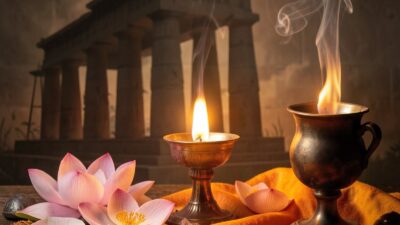
Choose one evening. Clear a small surface. Place a lamp or candle if it is safe. Keep a bowl of water or a flower if you have one. Sit for five minutes and name three forms of wealth you already hold—skill, a person who cares, a body that carried you through the day. Then name one need without bargaining or self-insult.
If prayer language is natural to you, address Maa Lakshmi simply. If it is not, sit with the lotus image and ask for clean rising. Either way, end by doing one concrete act of order: pay a small bill, tidy a drawer, send a thank-you message, cook a real meal. Myth becomes muscle when it touches Tuesday.
How This Differs From Empty “Abundance” Talk
Online abundance content often skips grief, class, and chance. Lakshmi’s world does not. Fields fail. Kings fall. The ocean must be churned. Her gold is bright because the story remembers darkness.
That is why a serious article about her can hold you longer than a tip list. You are not being sold a shortcut. You are being offered a companion for the long middle of life—where most of us actually live.
Closing: Let Her Walk You to the Door
Remember the quiet evening from the start—the paid rent, the humming worry. Maa Lakshmi does not mock that worry. She meets it with lotus and light, with coins that fall like responsibility, with forms that widen what counts as wealth.
If something in her story stayed with you—the mud and the bloom, the owl’s night sight, the warning about contempt—carry that one image into your week. And if you have a household practice, a Diwali memory, or a question about her forms, leave it in the comments. Real devotion and real doubt both belong in the conversation.